 Karlheinz Essl and I had our first meeting for his new piece, Whatever Shall Be, for toy piano, quadrophonic surround sound and gadgets today. After a few hours of trouble-shooting technical issues, we are now finally ready to unleash his new work this weekend! I am so honored that he wrote this piece for me and believe that it will be a real favorite among fellow toy pianists. Aside from some of the experimental and playful techniques he uses, the piece also has a richness and fullness to the sound world that really creates a whole new dimension to the toy piano. Concert is at at the Gary Snyder/Project Space (Chelsea) and begins at 7:30 pm. I will be sharing the concert with So Percussion and Merionalis. Laura Pellegrini will be hosting the concert and interviewing composers throughout the evening.  I hope to see you all on Saturday !
Here are some of Karlheinz’s program notes on Whatever Shall Be:
At the beginning of the 3rd millennium, I had a strange encounter with a strange instrument: the toy piano, which – at the first glance – didn’t attract me that much. On the contrary, I didn’t properly estimate its restricted sound possibilities and regarded it quite uninteresting and boring. My immature prejudice changed entirely when I borrowed a toy piano from Isabel Ettenauer who was asking me since years to write a piece for her. And now, after being forced to dedicate myself to this instrument I soon understood that it has nothing to do with the piano as we know it.
When I hit a key on a regular piano, I am not just hearing a note, but also the whole history of this instrument with its repertory from Bach to Boulez that the piano sound transports. This fact always makes it difficult for me to compose for piano as it always reminds me of historical music that I love – and also abhor.
This didn’t seem to happen to me when I was playing on the toy piano because its sound has nothing to do with a conventional piano. Instead of strings this instrument has metal rods which are hit by a hammer, producing sonic qualities that rather remind me of bells or a celesta, Asian gamelan, or even an African kalimba.
After writing my first toy piano piece in 2005 called Kalimba, I became more and more interested in scrutinizing the possibilities of this instrument. A few months later I composed WebernSpielWerk as a tombeau for Anton Webern. Here, the toy piano was utilized as a carillon – a very tiny one -, and in fact the piece was modeled after the generative sound installation WebernUhrWerk which was played at the 60th anniversary of Webern’s death from a loudspeaker hidden inside a roof at the market place of Mittersill where the composer was shot in 1945.
But that was not enough: In 2008, when I started my Sequitur project for various solo instruments with live-electronics, of course a piece for toy piano was on my agenda. But then, after having written already several toy piano pieces, I met Phyllis Chen in New York. It was a hot and humid summer day in 2009 as we sat together in a tiny park in Midtown, exchanging our experiences with this strange and fascinating instrument. That’s when Phyllis suggested to write another piece, for her. And I immediately said Yes!
In my previous toy piano composition, my aim was always to find a new perspective to this instrument. In order to break up the restricted sound world, I was hiding a tiny loudspeaker inside the toy piano for Kalimba which played back pre-produced sounds. WebernUhrWerk, however, is only played on the keys, and Sequitur V uses live-electronics which create a sonic house-of-mirrors solely from the live input of the instrument.
This time I concentrated on the “ugly” parts of the instrument which are commonly not regarded as musical: the guts apart from the keys – the body of the instrument. So I was approaching the toy piano like an innocent child who looks into the belly of the instrument and starts scratching and knocking here and there. In fact, due to the acoustic properties of the sound boards, this produces very rich and fascinating sounds. Then I mounted a contact microphone on the downside of the the sound board which was connected to a special computer program that I had conceived for this composition: a kind of sonic “particle accelerator” (like the ill-fated CERN in Geneva) which creates a maelstrom of sounds, swirling around the audience.
But there is yet another story which I have to mention in the end: When experimenting with the entrails of the toy piano, I realized that its sound board acts as a splendid amplifier for tiny sounds and noises. When putting a small music box inside, its lanky sound becomes strong and mighty, mixing nicely with the key sounds of the toy piano. That happens at the very end of the piece. And in fact everything that is heard before – rhythmical cells, melodic motives, even the harmonic structure – has derived from this little music box melody which arose from the great movie “The Man Who Knew Too Much” by Alfred Hitchcock. And the refrain of the song reads: “Que sera, sera, whatever will be, will be.”

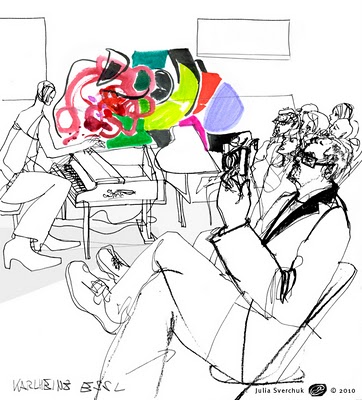 There were a number of artists at the Look & Listen concert last Saturday sketching during the performance. I found a few drawings from
  I am on my way back to New York City after my debut at the